
higher modelled fatigue capacity for F2 than XPS F4, at the same thermal index. F2 is, however, 250 mm thicker.
ACTIVA road dossier · October 16, 2026
ACTIVA: designing pavement for the site
Combine insulation, mechanical contribution and cast-in-place construction. Explore road applications, documented comparisons and the details that matter for a project.
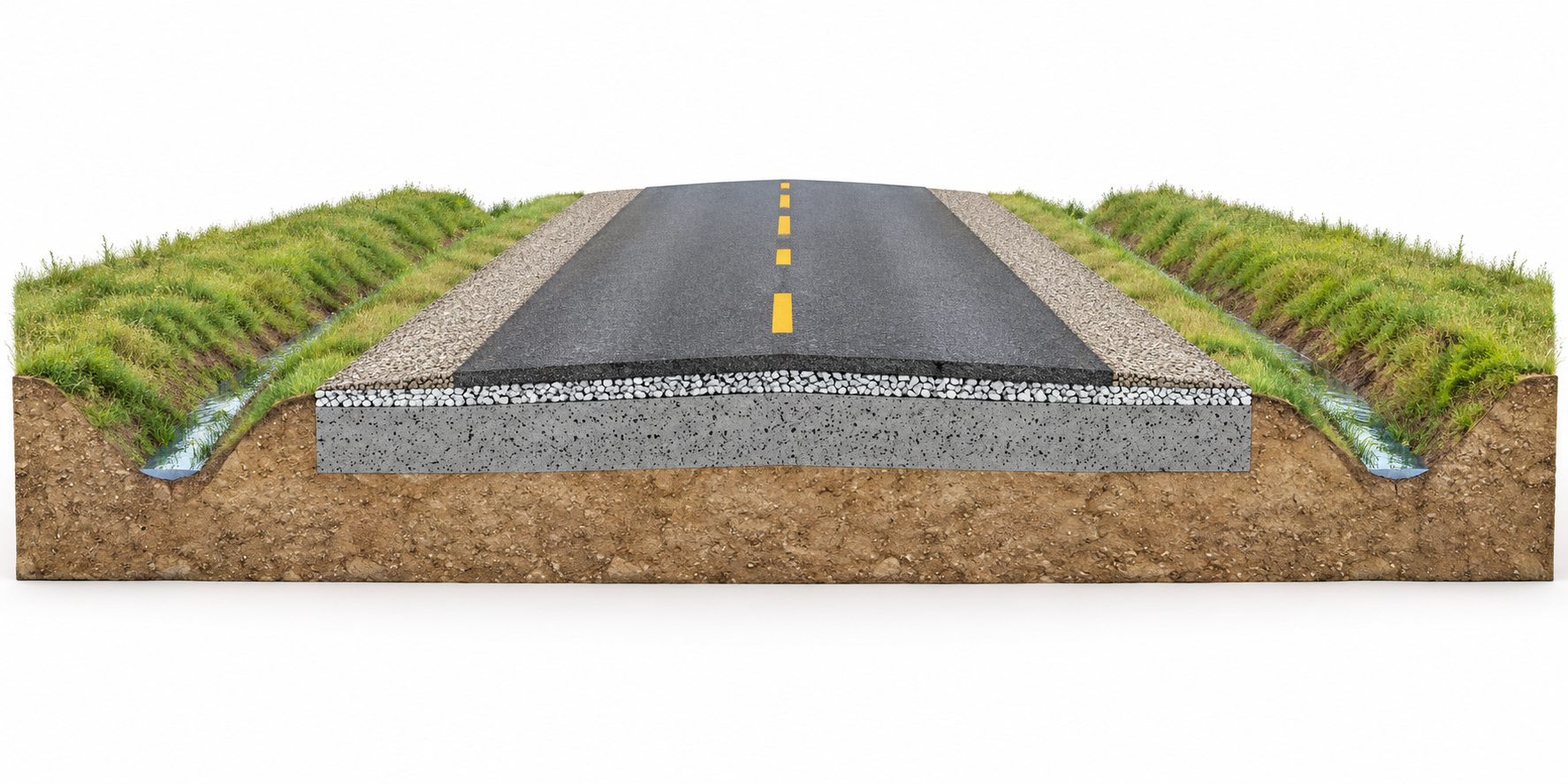
Compare complete pavement structures
in total thickness for F2 compared with reference F1: 1,365 mm versus 2,055 mm in the studied case.
| Studied structure | Total thickness | Thermal index¹ | Modelled fatigue² |
|---|---|---|---|
| F1 · Granular reference | 2 055 mm | 65.50 | 20.8 |
| F2 · Lightweight concrete | 1 365 mm | 73.78 | 23.1 |
| F4 · XPS | 1 115 mm | 73.78 | 14.0 |
Source: InnovAct Consulting, September 2020, § 4, Tables 2–5. ¹ A higher index means higher calculated thermal capacity in this model; it is not an R-value in SI units. ² Millions of equivalent single axle loads (ESALs). Results apply to the studied structures and are not a guaranteed service life.
Consult the source documentsFor F2/F1, with identical area and finished elevation, the difference represents 0.69 m³/m² of potentially avoided excavation and 0.99 m³/m² less granular material, with 0.30 m³/m² of lightweight concrete added. The economic study excludes excavation; this potential must be costed for the site.
Three settings, different priorities
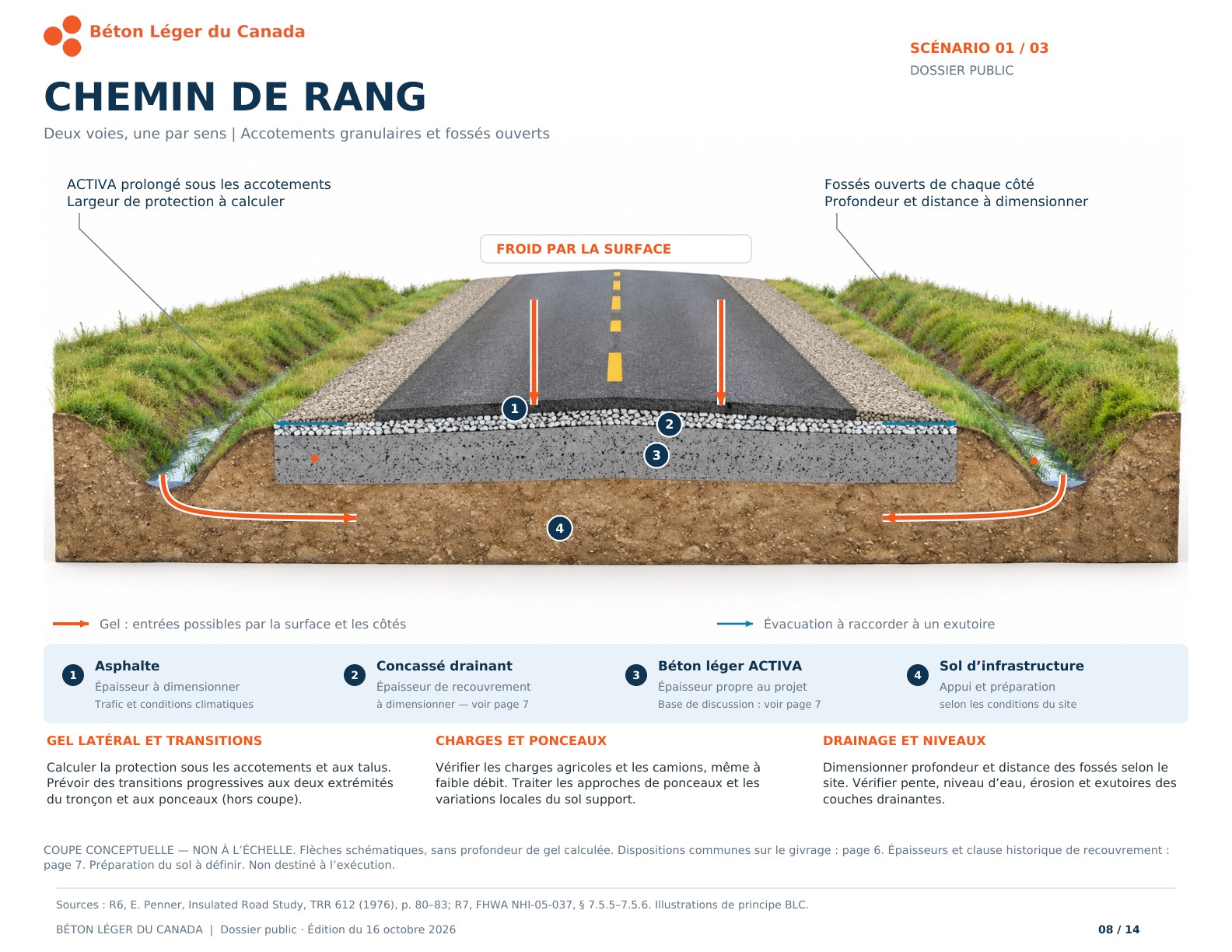
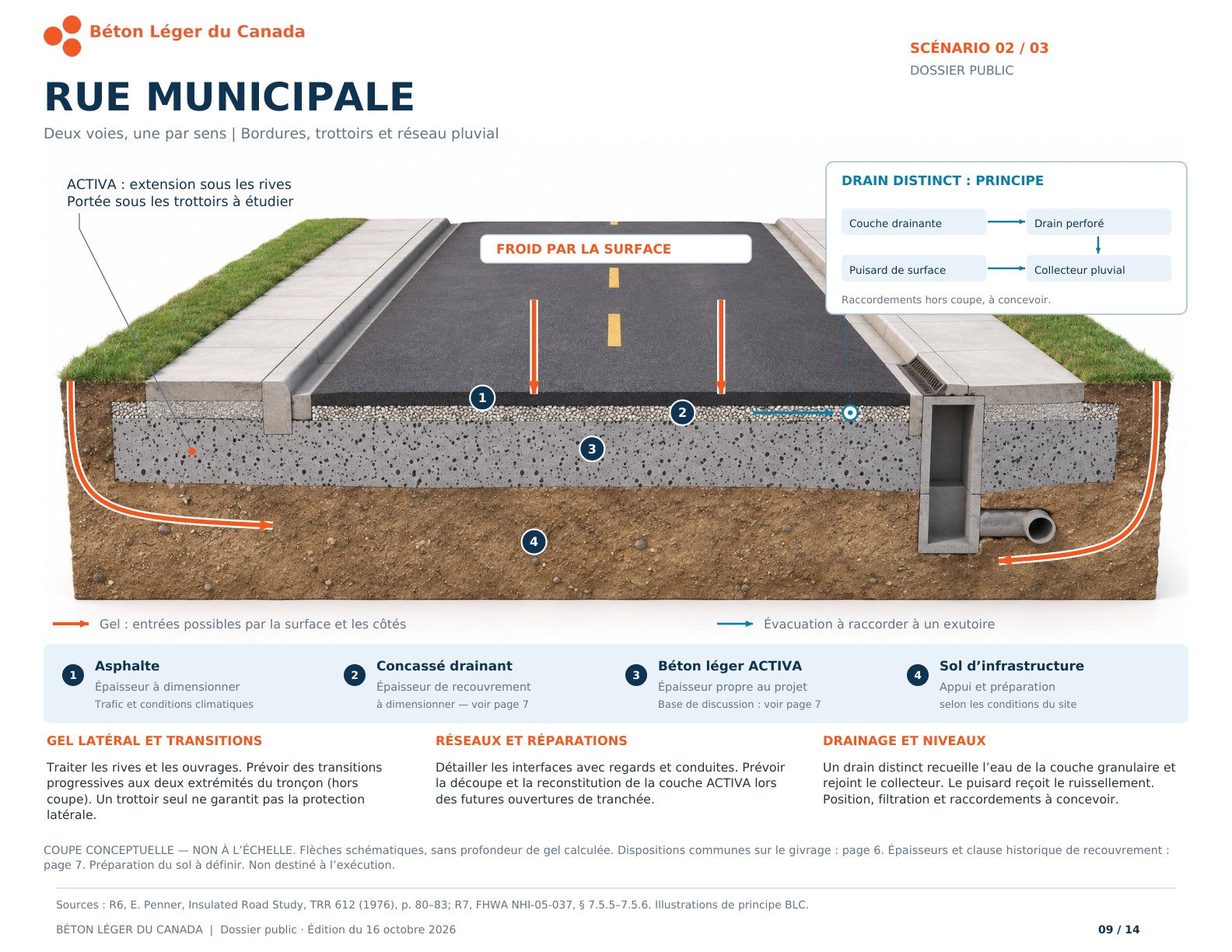
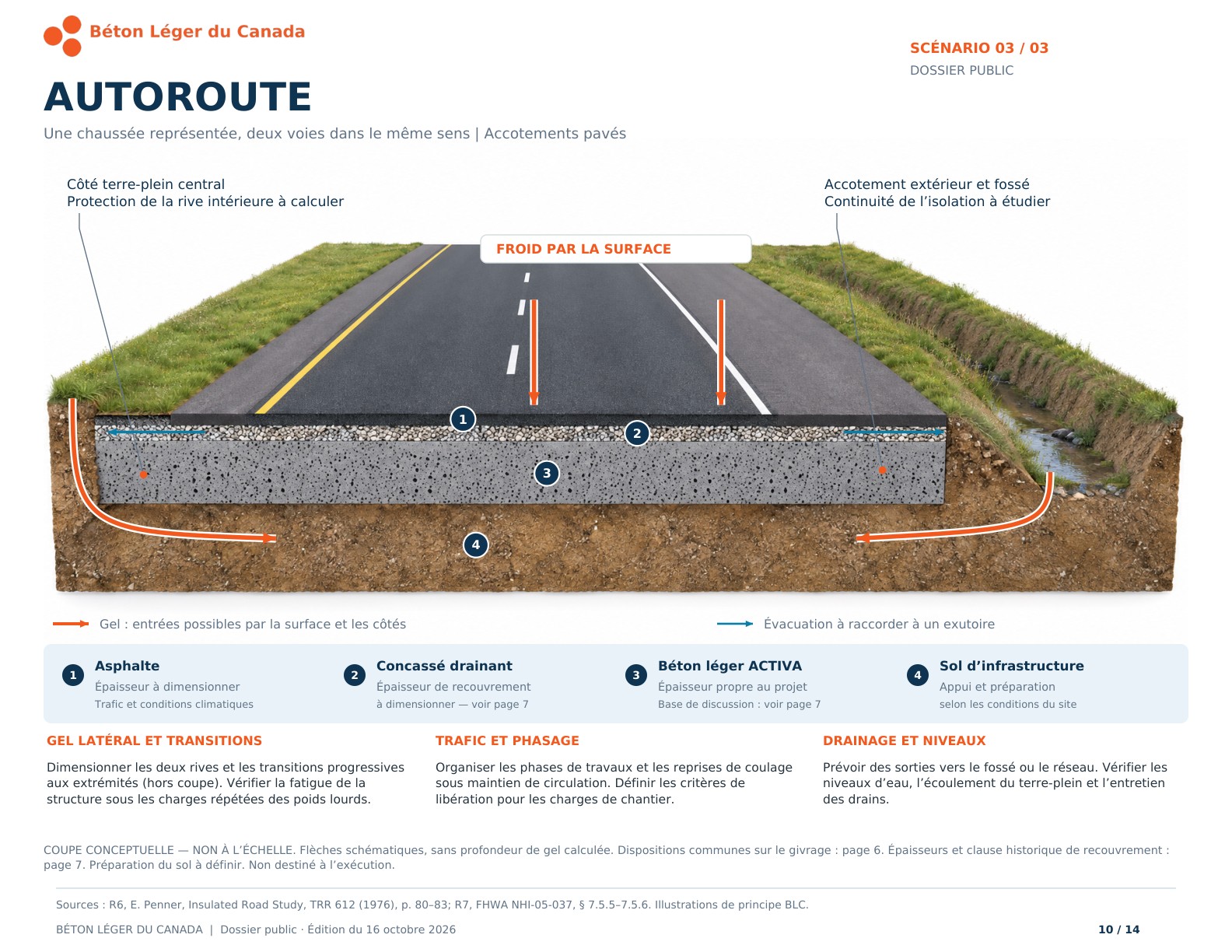
Conceptual sections, not to scale. Orange arrows show possible frost entry; blue arrows show drainage requiring an outlet. Illustrations and PDF are in French. Open the PDF to enlarge.
01 · Rural road
Ditches, shoulders and culverts: calculate lateral protection while accounting for agricultural vehicles and trucks.
02 · Municipal street
Curbs, utilities and manholes: provide a separate drain connected to the collector and plan reinstatement after utility work.
03 · Highway
Heavy traffic and traffic management: verify fatigue, both pavement edges, construction joints and work staging.
Details to address from the outset
Lateral frost and transitions
Design the protected width, ditch depth and setback. Provide gradual transitions at both ends of the section.
Water and drainage
Provide slopes, filtration, drains and outlets. A surface catch basin does not automatically drain the pavement layers.
Cover and surface icing
Design the cover and assess surface icing during rapid cooling. The historical MTQ clause specifies 450 mm of granular cover.
In-service thermal value
The historical conductivity of about 0.17 W/(m·K) was measured dry. Controlled-moisture testing is proposed to establish an in-service design value.
MTQ recognizes the product as proven for the evaluated formulation and pavement-insulation use. Layer thicknesses, drainage and verification under traffic remain project-specific.